Showing posts with label technology. Show all posts

11 August 2014

Transformers robots in disguise

Some very cool advances in technology I thought I'd post on today.

1. Origami Robots:
These crazy self-folding/self-constructing robots are inspired by Origami.
Check out the video.
Prof Wood, who is also part of Harvard's Wyss Institute for biologically inspired design said there were a huge number of applications for devices that self-fold.
"Imagine self-deploying structures - maybe shelters or structures for space exploration or for satellites," he told BBC News.
"Things where the logistics are difficult, like humanitarian aid in war zones."  "
2. Computer Chip full of artificial neurons.
Computer are fast when it comes to a lot of calculations, but there are some things the human brain can do better, but it maybe we are about to be outstripped.
I'm going to give a longer quote here: "Part of the reason is that both the architecture and behavior of neurons and transistors are radically different. It's possible to program software that incorporates neuron-like behavior, but the underlying mismatch makes the software relatively inefficient. 
   A team of scientists at Cornell University and IBM Research have gotten together to design a chip that's fundamentally different: an asynchronous collection of thousands of small processing cores, each capable of the erratic spikes of activity and complicated connections that are typical of neural behavior. When hosting a neural network, the chip is remarkably power efficient. And the researchers say their architecture can scale arbitrarily large, raising the prospect of a neural network supercomputer.


Conclusion: Together these things give the Transformers. Maybe one day we really will see Bumblebee and Optimus Prime - the thinking self-constructing robots of fiction could be made real.


25 March 2014

Technology Changes

Time passes with each slow incremental step. So often we don't even stop to think how our lives have changed, we just deal with the present. This little video reminded me how much even the little things can change in a relatively short space of time.


Well - that made me feel old. What about you? Old enough to have used a rotary phone, or were you with those kids?    :)

14 May 2013

Atoms and eyes

It's been a little while since I've done a technology post, so here are two cool snippets:

1) Atomic level movie
IBM have created the smallest movie ever by manipulating the atoms on a copper surface.
I know, crazy!
They've called it A Boy and his Atom, and it's essentially stop motion on a teeny tiny scale. "It would take about 1,000 of the frames of the film laid side by side to span a single human hair."
Andreas Heinrich says: "The atoms hold still in their new positions because they form chemical bonds to the copper atoms in hte surface underneath, and that lets us take an image of the whole frame of the film. Between frames we carefully move around the atoms to their new positions, and take another image."       To see click image.

2) Scientists have made a camera that works on the same principle as an insect eye.

This digital camera utilises the ideas behind an insects compound eye. Compared to normal cameras it has a great depth of field and is wide-angle without the usual distortion.
"The development team, led from the University of Illinois at Urbana-Champaign, US, believes its new imaging system could eventually find uses in surveillance and for endoscopic investigations of the human body."

23 April 2013

Wearable technology

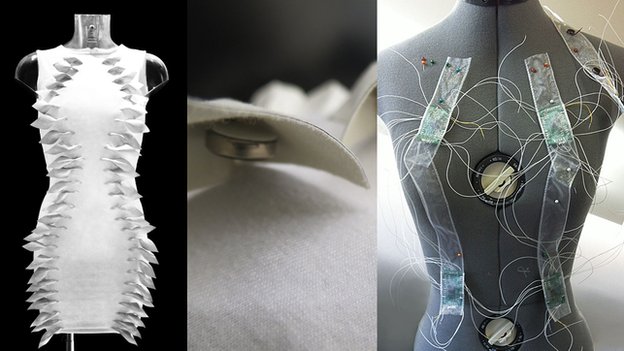
Ever wondered when our clothes will take the next step - after all much around is starting to? Our fridges can order groceries and our phones no longer simply place calls. Beyond simply covering our bodies what can it do? With the advancements in technology inventors are asking whet our clothing can do beyond just covering our bodies.I thought I would share some of the snippets I've spotted :)

Defense:
- Technology students in India have invented a bra that shocks would be attackers. It delivers a 3800kv electric shock to any would-be rapist, enough to cause severe burns. It can also send a text message to a relative or friend and the local police station, with the GPS coordinates of the victim's location, says inventor Ms Mohan.

Art:
- A California company called Machina has created a jacket that makes music. "We wanted to change that. We wanted to bring the act of performance back to life by having the musician use his/her body as an interface, says co-founder Ms. Machina.

- Machina is not the only one combining music with jackets. MIT media Lab & Levis also a a product, this one has a keyboard embroidered with conductive thread.


Medical:
- A university of Colorado student has come up with a dress that not only looks kinda cool, but can help people with hearing impairment 'feel' the direction of sound. "I wanted to create something that used the landscape of the body as an interface to communicate things about the outside world, in a different medium" says inventor Ms Profita.
 - Or clothing that monitors various vital signs of the wearer such as heart rate, respiration rate, temperature, activity, and posture, like the one developed by Georgia Tech. No super attractive in its raw form, but cover it with an over layer & it could look however a designer fancied.

Where else is this technology going to take us?
Personally I'm 100% behinfd Quoc Truong, physical scientist at Natick Soldier Research, Development and Engineering Center, wants to make self cleaning clothes. A world without dirty clothes, sounds like a wonderful place to me :)

16 April 2013

Food inventions

Food, glorious food!  
What wouldn't we give for  
That extra bit more -- That's all that we live for  
Why should we be fated to  
Do nothing but brood  
On food, Magical food,
Wonderful food,
Marvelous food,  
Fabulous food. -- Oliver (musical)

You guessed it the topic for today is food inventions :)

I know Mythbusters has tested the ice bullet - but what about the chocolate one?

 Then what about this for breakfast? One little robot that does it all. (link this this & rest)


Naturally after breakfast you're going to need a cup of coffee, but the last thing you want is for that to interfere with Twitter or your latest text. Trying to balance them all with out help could be disastrous.

 Then lunchtime rolls around - too busy to stop work, here's the answer. This one I want. The number of times I have to turn my keyboard upside down & shake out the crumbs (sigh)

 At last time for dinner. Want to talk, watch a movie, read... whatever, now you don't have to worry about holding your phone, your crockery can do it for you.

Finally, after all that, it's time for dental hygiene. Can't take the time to brush your teeth, why not wear one of these - it's not creepy at all.


14 November 2012

Cool inventions

2 very cool inventions this week and the shades of sci-fi that surround them: an inner ear implant that uses biology to recharge, & self-fixing concrete.

Technology that uses people as power - shades of The Matrix anyone?   :)
No we haven't quite got that far yet, but we have got to a place that should make huge breakthroughs in medical science.
"A team of surgeons, neuroscientists, and electrical engineers has developed a cochlea chip that extracts electrical signals from the inner ear to power itself.
The chip is the latest in a series of inventions aimed at creating entirely self-sufficient, self-powering implants that will remove the need for external power and enable permanent surgical implantation in some cases. This year alone, Stanford University announced the creation of its radio wave-powered heart implant and infrared light-powered retinal implants."
 Ever seen someone who looks a bit embarrassed about their hearing aid - that could soon be a thing of the past. Get these things small enough and soon no one will know you're wearing one.
On a different sci-fi tack, where does this leave us for things like super-soldiers with super hearing?

From ears to concrete. There is now experimental concrete that self-heals it's own cracks.
"The concrete contains limestone-producing bacteria, which are activated by corrosive rainwater working its way into the structure... Micro-cracks are an expected part of the hardening process and do not directly cause strength loss. Fractures with a width of about 0.2mm are allowed under norms used by the concrete industry. But over time, water - along with aggressive chemicals in it - gets into these cracks and corrodes the concrete...
"So the spores remain dormant until rainwater works its way into the cracks and activates them. The harmless bacteria - belonging to the Bacillus genus - then feed on the nutrients to produce limestone.
The bacterial food incorporated into the healing agent is calcium lactate - a component of milk. The microbes used in the granules are able to tolerate the highly alkaline environment of the concrete.
"In the lab we have been able to show healing of cracks with a width of 0.5mm - two to three times higher than the norms state," Dr Jonkers explained."
What about the sci-fi overtones you ask? Well, as I read this article images from sci-fi movies with cities in decay came to mind. If the concrete self-healed those cities would look quite different.
How eerie if the city is far more perfectly preserved – although I imagine the plants would still get involved.

06 November 2012

fly away - printed plane

Ever spent hours & hours building a model plane? Painstakingly cuting & glueing? ever thoguht of just printing one out and going for it? Two student engineers have done just that.
And, okay, I'd better confess that I'm not the model plane kinda gal, but printing one out - that sounds pretty cool... and not quite a simple as I've made out.

Two University of Virginia engineering students got to build an unmanned aerial vehicle, using 3-D printing technology. "In other words, a plastic plane, to be designed, fabricated, built and test-flown between May and August. A real-world engineering challenge, and part of a Department of the Army project to study the feasibility of using such planes."

So not just printing out, but designing as well. Of course once they've designed it, (and it's working), there's nothing to stop anyone else, say the military, from prinitng them out and just going for it.

The unmanned aerial vehicle, "dressed" in U.Va.'s colors. The plane was built entirely from parts from a 3-D printer.


This whole 3D printing idea is rather sci-fi when you think back ot hte good old dot matrix. All those years ago, while pulling those horrible little hole strips off the side of sheets of papaer, I never would have guessed that one day printes would be playing in 3D.

"Three-dimensional printing is, as the name implies, the production or “printing” of actual objects, such as parts for a small airplane, by using a machine that traces out layers of melted plastic in specific shapes until it builds up a piece exactly according to the size and dimensions specified in a computer-aided drawing produced by an engineer."


All so simple, and if you break it - just print a new one :)


25 September 2012

Bendy-camouflage robot

Very cool bit of tech, bendy-camouflage robot. It's been a little since a tech post - and this I couldn't resist.

Now you see it ..... Disappearing ... gone.


Well, virtually, the video jumped before I got the final picture. It also glows in the dark if the researchers want it to. It was inspired by the camouflage skills of sea creatures such as octopuses, cuttlefish and squid.

Professor George Whitesides, an author of the paper, said: "Conventional robotics is a pretty highly developed area, and if you look at various robots you find that most are basically built on the body plan of a mammal. Our question is: Why do you have to do that? Why not think about organisms that are soft, that might have quite different structures and ways of moving and strategies for camouflage. And the obvious place to look is underwater."

Very cool, Professor, very cool.I image the uses for something like this, with it's squidgy body and can squeeze places and change color, are innumerable, even my fertile writer's brain can't keep up :)

29 May 2012

It's been a little while since I've done a technology post so brace yourselves :)

A new robot "cheetah" has entered the scene.
It's not really a cheetah (of course) it doesn't even have a head, but it is fast (fast for a robot that is).
Fascinatingly the machine is designed to flex and un-flex its back to increase the length of its stride.
It's been designed in conjunction with US defense so clearly military uses are intended, the biggest problem is that without a head there's no brain - how is it going to know what to do?


Okay, I know robots don't need heads to store their brains, technology can put microchips anywhere, but until they sort out the AI on this I don't think it's going to be ready to be released into the wild.
Still very cool tech.

07 February 2012

Page turner

Ever just want to sit and read without all the hassle of turning the pages yourself?
Loved this little video - when he's finished reading the first page, well no need to put down the coffe cup to turn it over :)


17 October 2011

eGadgets: men vs. women

eReaders vs. tablets. Men vs. women.

     I came across a fun little article that looks at recent AC Nielsen data, and asks if it's too soon to be making gender stereotypes. Apparently recent surveys show that women love their eReaders and men their tablets. 61% of reader owners were women; 57% of tablet owners are men.
     Now I'm not sure one way or the other. After all, the stats are pretty close, but the first thing I thought... I love my Sony Reader and my husband loves his iPad. hmmmm

 Other interesting snippets:
Phones on the other hand are "equal handed" in male/female ownership.
And older users are starting to pick up the new tech.

Technology is changing so fast, nonetheless in's interesting to see where we are, and to wonder where we'll end up :)

19 September 2011

bathtime books

Book Gossip: Who hasn't been late for work because they just couldn't put that book down? Who hasn't wished for a reading stand and a waterproof book so they could wash and read at the same time?

Well, the waterproof book is here (although the selection of titles is somewhat limited. I guess the reading in the shower crowd is limited). Currently waterproof books are used mainly by divers and foul-weather hikers, but things may be about to change. Soon, if the title you're after is on offer there'll no reason not to sink neck deep in bubbles in the tub and enjoy a good read. Or maybe it'll a chance to read to your kids during bath time and not worry about splashes.


The new wetable books are made from plastic resins and inorganic fibers, not wood-based paper.
Melcher Media, a New York-based publisher, is promoting books that are manufactured using a technology it calls "Durabooks." Other technology uses a clear wax sealant to prevent ink running and to stop pages getting soggy and tearing. The tough polymer coating is also tear-resistant.

Rumors say waterproof books will hit the shelves next year. With eBooks taking a greater & greater share of the book market there needs to be a good reason for people to buy the hard-copy - maybe this is it. Of course, now all they need is a waterproof eReader and I'm set :)

30 August 2011

Technology

We've all got things we love. Stories that inspire us.

But when it comes to being inspiring, I can only hope that one day I get a fraction as inspiring as this next image. This guy not only loves the story, he loves the gadgets. On top of that he has skills a lot of us simply don't have to make stories come to life in our lives. Except, what's even more inspiring - he learnt a lot of those skills simply to bring his dream to life.


When it comes to famous cars this one's special because, well, it's not real... except now it is. This is a replica of the Batmobile from the latest Batman movies. Bob Dullam built this cool car from scratch over the five years.

And when it comes to cool tech this next invention is awesome.


Researchers have developed a universal robotic hand - they call it a gripper - but that's just fancy science language for hand  :)  Except that by thinking of another term they progressed further. Language can take us beyond the bounds of our minds, or this reality, it can also trap us. When we use the word hand, we think of a specific thing. That limits us. It limits us to fingers etc... By not using the word hand these researches weren't limited to fingers, and they came up with a new concept.

The gripper is actually a balloon which conforms to and grips almost any small object strongly enough to pick it up. To grip an object, the gripper creates a vacuum in the balloon, later it's then  to let go of the object just by releasing the vacuum.

Very cool. The power of ideas and of language.